• An interesting question, if you have to get a task done, which is more helpful motivation or discipline?  An interesting article titled “Screw motivation, what you need is discipline” contrasts the two:

    “Motivation, broadly speaking, operates on the erroneous assumption that a particular mental or emotional state is necessary to complete a task.

    Discipline, by contrast, separates outwards functioning from moods and feelings and thereby ironically circumvents the problem by consistently improving them.”

    Clearly a not so subtle answer to the question but it hits on a really important point: people are generally lazy.  A little explanation is required.

    A common misconception is that somehow what we feel and think drives what actions we take, a clear cut cause and effect.  The reality (as often is the case) is quite a bit more complicated.  Actually, our feelings and thoughts are much more intertwined with actions than our intuition lets on.  Let’s do a thought experiment.

    You come home from work and are feeling a general malaise; if you were a colour, it would be grey; if you were the sky, it would be cloudy; if you were a word, it would be “blah”.  Now, what would you do in this situation?  Probably plop yourself on the couch, turn on the TV and zone out for the next few hours [1].  So clearly, feelings/thoughts caused you to do this drab activity, or did it?  Let’s look at an alternate reality.

    You come home from work and are feeling a general malaise; if you were a colour, it would be grey; if you were the sky, it would be cloudy; if you were a word, it would be “blah”.  As you are about to plop yourself on the couch, the alarm on your phone goes off reminding you that you’re supposed to go do your 6 pm workout (4 times a week no less!).  So you moan a bit and drag yourself to change and go for a run outside.  After the run, how would you feel?  Some words that I might use (depending on how the run went): tired, exhausted, energized, proud, happy, relieved, satisfied… the list goes on.  In no case though would I imagine that we would use the word “blah”.  Interesting isn’t it?  The action of running really caused our feelings (and most likely thoughts) to change.  So the cause and effect of feelings and actions aren’t so clear cut after all.

    Now circling back to the original question: motivation or discipline?  Of course, we’d prefer motivation.  Motivation makes things easy.  When we’re really raring to hike up the mountain, it becomes (almost) fun.  When we’re determined to finish that assignment, it becomes effortless.  When we’re hungry to learn that new lick, practice seems like a breeze.  We like motivation because we like things easy.  The opposite is also true, we don’t like things hard, which is just another way to say we are lazy [2].  But clearly the article is onto something that is obvious to everyone: we don’t always have motivation.  Some tasks are hard, sometimes we can’t see the finish line and we lose motivation.  And this is the reason discipline is so important.

    Discipline gives us a reason (along with habits) to do some kind of action that we would normally not do left to our own devices.  And here’s the part that’s unintuitive: discipline can affect *gasp* your motivation.  So then, discipline is a tool to help us get stuff done but also to help us gain motivation.  It’s easy to see examples all over the place such as when a kid does well on his math test because he did all his homework, it will encourage him to study more next time.  Or perhaps practicing a guitar solo every day for a month, and then killing it at an impromptu performance for your friends.  And we can’t forget everyone’s favorite activity of seeing the pounds on the scale go down through a consistent exercise regimen (and probably reduced calorie intake).  Discipline can help us do more particularly through difficult tasks, and ironically make them easier (by giving us motivation).

    So now then, motivation or discipline?  Both of course!  Not sure why there always needs to be a dichotomy between things.  We should use the right tools for the right job, and both motivation and discipline are two powerful and complementary tools.  Because you never want to be left with just one tool, as the old saying goes:

    “To a man with a hammer, every problem looks pretty much like a nail.”

    I don’t know about you but most of my problems are much too varied and delicate to use a hammer.  Now a screwdriver on the other hand…

    1. Obviously dating myself a bit.  How about something more modern?  Plop yourself on the couch, open up YouTube on your iPad, and spend the next few hours watching videos of cats spinning in circles.[]
    2. Laziness isn’t necessarily a bad thing.  Sometimes great innovation comes out from being lazy (as a way to avoid doing things that are hard).  Moreover, it’s just a fact of human nature (and nature) that we try to minimize hard things.  We don’t lament our limited capacity to see the visible light spectrum, why attach negative connotations to our natural tendency to be lazy?[]
  • main-qimg-becd53fa321a6a527ea6fc1072635e17

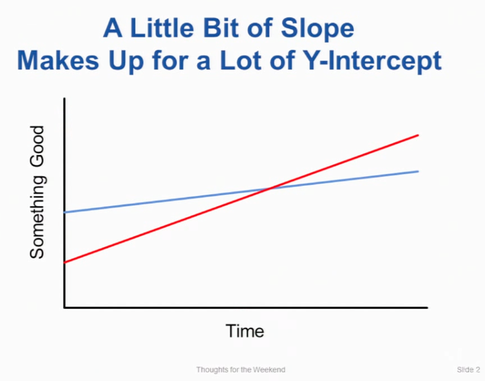
    Math can sometimes be useful in explaining things.  I came across this witty quote from Professor John Ousterhout.  He’s a computer science professor at Stanford that spends 15 minutes every week in his lectures giving a life lesson.  This is one of my favourites.

    The basic idea is you want to be the red line and not the blue line.  From one of his lectures (emphasis mine):

    “So in a mathematical sense it’s kind of obvious.  But I didn’t really mean in a mathematical sense, I think this is a pretty good guideline for life also.  What I mean is that how fast you learn is a lot more important than how much you know to begin with.  So in general I say that people emphasize too much how much they know and not how fast they’re learning.

    So I think this is a really interesting concept you can apply in a lot of different ways.  And the key thing here I think is that slow and steady is great.  You don’t have to do anything heroic.  You know the difference in slopes doesn’t have to be that great if you just every day think about learning a little bit more and getting a little bit better, lots of small steps, its amazing how quickly you can catch up and become a real expert in the field.”

    I’m sure this isn’t the first time you’ve heard something along the lines of “be a lifelong learner” or “learn something new everyday”.  There are so many variations on this cliche that it’s not really that interesting anymore but that doesn’t mean it’s not good advice.

    What I really enjoyed about this rephrasing is the visual.  It allows you to look at what’s currently happening (x=0) and what could happen in the future (if you’re focusing on “slope”).  Everyone has known someone who is the blue line.  The know-it-all genius who seems to be better or know more than you.  But what’s interesting is that edge usually disappears relatively quickly if they’re not focused on “slope” (which I’ve seen happen to many bright people more often than not).

    Focusing on “slope” is hard though.  Sometimes it’s a grind.  But that’s not unlike most things in life.  The people who can “grind” away and focus on the “slope” are ultimately the ones who are setting themselves up for success.  Definitely not sexy (it is math after all), definitely not romantic, just the reality.

    Random thought: Instead of focusing on “slope”, you should be focusing on the “slope” of your “slope”, or the “slope” of your “slope” of your “slope”, or … On second thought, maybe just “slope” is fine.

  • What’s the difference between a good bet and a winning bet?  Let’s look at some examples:

    • A good bet is betting $10 to win $15 in a fair coin flip; a winning bet is winning $10 by betting $15 in a fair coin flip.
    • A good bet is getting a university degree; a winning bet is dropping out of university and starting a unicorn.
    • A good bet is buying a company with solid earnings at a discounted price; a winning bet is buying Amazon in 1998 and selling in 1999. [1]

    Get it?  A good bet is one that has good odd whether or not it wins in the end; a winning bet is one that is won whether or not the odds are good.  That is, unless you can predict the future or are incredibly lucky, your best outcome will be with a good bet.

    Although it’s simple to understand, it’s sometimes hard to do in practice.  Like when you get beat bad in a poker game (even though you totally made the right decision), or your thesis is proven wrong on a stock you bought (that you researched thoroughly).  It’s seldom reassuring to know that you made a “good bet”, when you’ve clearly lost.  But try not to get down, it’s the culmination of all the little things that add up to something meaningful.  It’s a string of good bets that make for good results.  Which reminds me, the jackpot for the lottery is at $41 million this week…


    1. There is some controversy on whether or not Amazon is a good investment (not whether or not it provides valuable services — I love shopping on Amazon).  One camp thinks that they’re going to go gangbusters once they raise their prices after they’ve crushed all their competitors; the other camp thinks that they’re incredibly over priced for the meager amounts of profits they have.  Put me squarely in the second camp.  I’m more of “good bet” not “winning bet” kind of person when it comes to investment, something more along the lines of Walmart.[]
  • I subscribe to Businessweek, a weekly magazine business magazine published by Bloomberg.  At the end of each magazine there is a section called “How Did I Get Here?” which profiles famous people (CEOs, entrepreneurs, celebrities etc.) with a timeline of their accomplishments.  It also features a section at the bottom of the page called “Life Lessons” that features three quotes from the person summing up their advice for “Life”.  I thought that might be kind of fun to see what I could come up with (and if it changes in the future).  Here are my top three life lessons as of today:

    1. Understand how the world actually works and not how you wish it to be. [1]
    2. The best way to get what you want is to deserve what you want. [2]
    3. Figure out what’s most important and make sure it gets the attention it deserves.  [3]
    1. Maybe this is a bit too pragmatic but that’s kind of my personality.  Upon reflection, the ones who make big waves are usually the dreamers but it’s important to note that most dreamers, by definition, don’t make big waves (because big waves are so infrequent).  I remember reading that there are two ways to go about being successful: learning to play extremely well within the existing rules, or by not following the rules.  Both are paths to success but with very different challenges.[]
    2. Shamelessly paraphrased from Charlie Munger.[]
    3. Hint: It’s rarely money or your career.[]
  • Some of the best minds in the world are working tirelessly, spending millions to determine how to motivate us to be more productive in our daily lives.  I could’ve saved them a lot of time and effort by just telling them about Grandma’s Rule:

    Grandma’s Rule is that you eat your vegetables if you want dessert.

    To most parents, this is obvious; in fact, it’s a common parenting technique that has been around for ages.  Psychology researchers have even figured it out in the 70s and have called it Premack’s Principle.  It’s simple and extremely effective.

    The main idea of Grandma’s Rule is that there are generally things you don’t like doing but you know are good for you (e.g. eating veggies, exercising, doing your homework) as well as things you like doing (e.g. playing games, indulging in dessert, watching a movie).  Left to our own devices, we tend to do what we like doing instead of things we don’t like doing even though they’re beneficial for us.  Pretty obvious, right?  The more difficult question is how do we get ourselves to do these less desirable but beneficial things.  The answer is simple: Grandma’s Rule.  Only allow yourself to do the pleasurable activity once you have finished all the unpleasant but beneficial activities.  It’s a super power for productivity and it’s easy to see why.

    Every time you do unpleasant activities, you get rewarded with a desirable activity i.e. positive reinforcement.  Over time, these unpleasant activities become less and less unpleasant because of the positive reinforcement of the reward, making them easier (and more likely) for you to do them.  Moreover, the additional boost to productivity gives you more positive reinforcement because you’re getting so much done, which encourages you to keep doing it and getting more done.  In engineering terms, we call this a positive feedback loop.

    There are probably only a few dozen really important ideas that can carry 80% of the freight in your life, and Grandma’s Rule is definitely one of them.  Before I finish off, I want to retell an anecdote that Charlie Munger mentioned in one of his speeches.  He tells us of a very well paid psychologist who runs around America telling executives how to manipulate themselves to be more productive using not much more than a disciplined application of Grandma’s Rule.   This psychologist basically tells the executive to organize their day so that what’s unpleasant and important gets scheduled first and then reward themselves with something they really like doing afterwards.  The executive see that it works marvels and with the obvious gain in productivity the psychologist gets paid very handsomely.  Granny was a very wise woman.

    An idea doesn’t have to be complicated for it to be extremely effective.  Granny’s rule is definitely one of these super effective yet simple ideas [1].  Although truth be told, I am questioning a bit if it works all the time.  I actually do like eating vegetables before dessert, so maybe it won’t work for me in that case.  Unless, it already has worked… *Mind Blown*.  Granny was a very wise woman.

    1. Another important one is the golden rule, which has been around for at least a couple of millennia.  It’s clear that the idea of reciprocity is something that is tightly linked to human societies.[]

Top Posts

Past Posts